Synthetic Jest and the Great Bengali Smile Factory
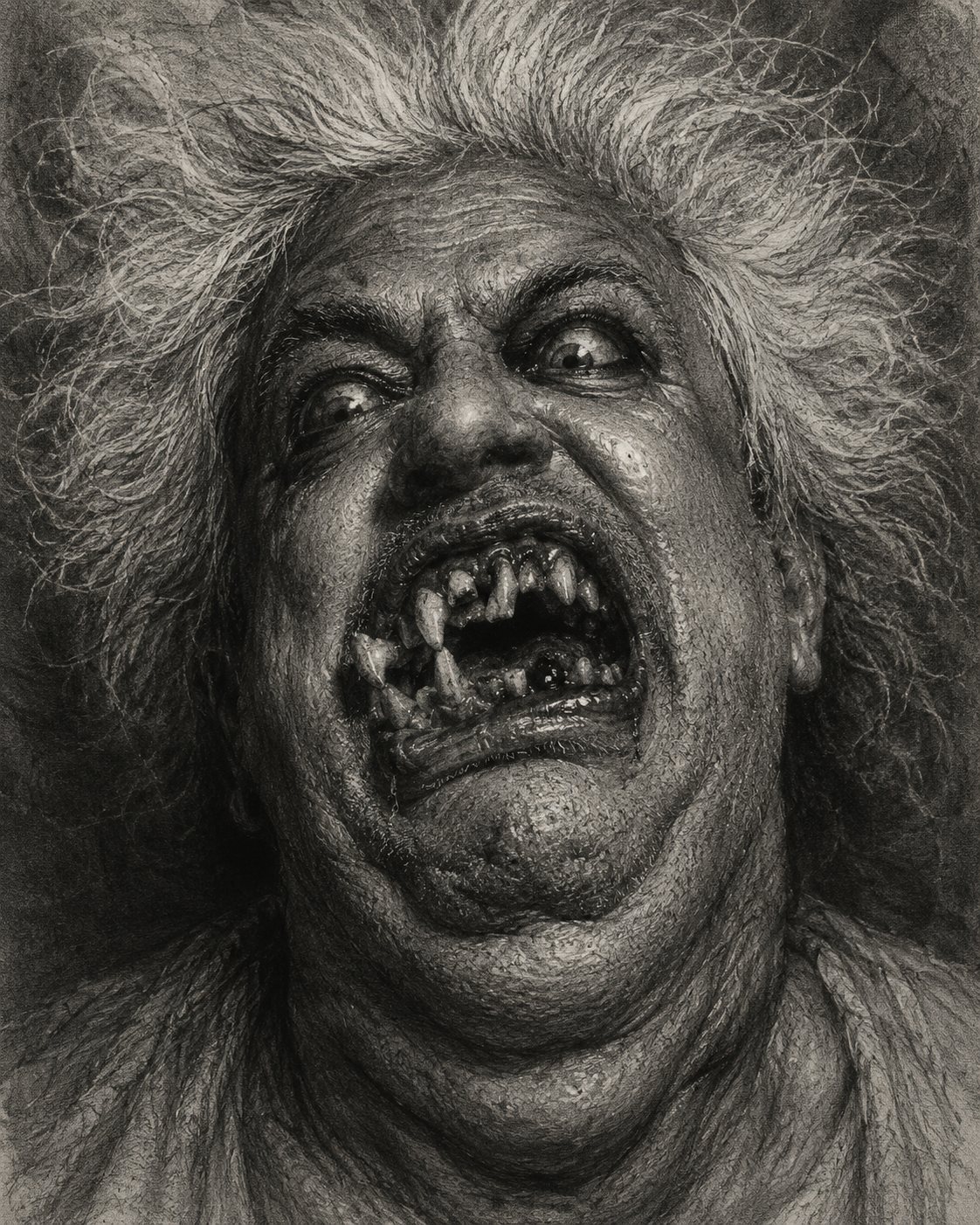
There is a kind of smile now that should be registered with the municipal health department.
You know the one. Teeth out. Eyes dead. Cheeks lifted like two shutters in a storm. A smile so sugary that ants would reject it on medical advice. It appears at weddings, office meetings, school functions, apartment get-togethers, political stages, religious ceremonies, LinkedIn posts, prize distributions, family WhatsApp photographs, and those birthday videos where forty-seven adults clap around one terrified child while a cake melts under tube light.
This is not happiness.
Happiness is a more disobedient animal. It comes wearing a faded banyan. It laughs with fish bone stuck in the gums. It forgets to adjust its hair. It says, “Arre, ki holo?” and then collapses into laughter because someone slipped on wet moss near the bathroom. Happiness does not ask for lighting. Happiness does not wait for the photographer. Happiness does not say, “One more candid, please.”
What we have now is synthetic jest.
The laugh is not born. It is installed.
It arrives preloaded, like those useless apps on a new phone that nobody asked for and nobody can remove. You go to a wedding in Behala or Salt Lake or some banquet hall near the bypass where the chandeliers hang like nervous fruit, and suddenly everyone is laughing. Not because anything is funny. Because the social machine has started. Someone has made a small remark about weight, salary, marriage, exam marks, skin color, or foreign placement. The target smiles. The others laugh. The cruelty is dipped in syrup and served as affection.
This is how Bengal became modern without becoming honest.
Once upon a time, and I am not saying it was a golden age because nostalgia is just cataract with poetry, people at least had the decency to look miserable when they were miserable. The uncle at the tea stall could complain about fish prices for twenty minutes with the gravity of a man reporting troop movement. The retired schoolteacher could sit on the balcony and look disappointed in civilization. The para auntie could disapprove of your haircut openly, with no motivational sticker attached.
Now everyone must be positive.
Positive means smiling while sinking. Positive means saying “all good” when your bank balance looks like a famine-struck pond. Positive means posting “new beginnings” when life has actually thrown you into a room with no fan and a chair with one short leg. Positive means laughing at jokes that are not jokes but tiny social knives wrapped in mishti doi.
The worst part is not the fake smile itself. We Bengalis have survived worse things, including committee meetings, watery mutton curry, and poems recited after dinner.
The worst part is that the fake smile has become a moral duty.
If you do not smile, people think you are arrogant. If you do not laugh, people think you are jealous. If you sit quietly, they think something is wrong with you. Of course something is wrong. You have been trapped for three hours in a room where one man is explaining mutual funds, one auntie is asking why you are still unmarried, and one cousin is showing Dubai photos as if he personally invented international aviation.
Try keeping your face cheerful under these conditions.
I am fifty-one. I live in the southern-edge, half-city, half-forgotten-bus-route part of Kolkata where the lanes have more memory than drainage. Morning begins with crows, pressure-cooker whistles, a milk packet slapped on a railing, and some distant neighbor conducting a full cabinet meeting over the phone. I make tea. I look at the laptop. The laptop looks back like a creditor. Somewhere in the world, AI is allegedly transforming humanity. Here, the ceiling fan is making a sound like a philosophical goat.
Then the phone lights up.
Someone has posted a family photo. Everyone smiling.
Someone has posted a motivational quote. Smile more.
Someone has posted a reel. Laughing emoji.
Someone has posted a political victory, a religious festival, a child’s certificate, a gym selfie, a hospital discharge, a new flat, a new car, a new sadness wearing lipstick. Everything is decorated. Everything is announced. Everything is converted into proof that life is going well.
But look closely.
The eyes are often not laughing.
The mouth has become a hired band. The eyes are the real family member sitting in the corner saying, “This is nonsense.”
There is a reason fake laughter looks ugly after a point. It stretches the face in one direction and the soul in another. It is like pulling a bedsheet over a broken cupboard. The shape still shows. Resentment shows. Fatigue shows. Fear shows. The mouth performs comedy, but the eyes are reading the electricity bill.
Indian modernity has given us many useful things, no doubt. Digital payments, better roads in some places, online tickets, video calls, medicine delivered home, and the ability to buy a pressure cooker gasket at midnight from a phone while wearing a lungi. This is progress. I am not against progress. I am against the strange circus tent we have built on top of it.
Because along with modern life came modern performance.
Every child is talented. Every house is blessed. Every marriage is beautiful. Every job is exciting. Every business is growing. Every event is grand. Every local club function has a banner large enough to shade a small district. Every man with a microphone believes he has been summoned by history. Every mediocre thing has become “iconic.” Every awkward family gathering is “memories.”
Memories, yes.
Like indigestion is also memory, only lower down.
The Bengali middle class has added its own masala to this curry. We do not merely perform happiness. We analyze it while performing it. We stand in the social circus, wearing the clown shoes, and give a lecture on the decline of clowning standards. We know the smile is fake. We know the laugh is forced. We know the compliment is hollow. We know the poem is bad. We know the biryani has surrendered. Still we say, “Darun hoyeche.”
Why?
Because honesty has a cost.
Say the truth in a Bengali family and watch the furniture tremble. Say, “I am lonely.” Too heavy. Say, “I am broke.” Too embarrassing. Say, “This job is killing me.” Too negative. Say, “This marriage is a museum of silence.” Too scandalous. Say, “Your joke was cruel.” Too sensitive. Say, “I do not enjoy these gatherings.” Too antisocial. Say, “I am tired of smiling.” Too dramatic.
So we do the safer thing.
We grin.
We grin at the successful man who became successful by methods best discussed in whispers near a closed window. We grin at the relative who measures human worth in salary slips. We grin at the office boss who calls exploitation “ownership.” We grin at the neighbor who asks personal questions with the innocence of a crow examining a fish head. We grin at the cultural program where the harmonium is louder than mercy.
And slowly the grin becomes a mask.
Then the mask becomes the face.
This is where the image becomes frightening. Not because it is a monster. Monsters are easy. Give them fangs, claws, background thunder, and a poor lighting budget. Done. The real horror is a human face that has been asked to perform joy too long. The smile widens. The eyes panic. The teeth come forward like unpaid bills. The cheeks inflate. The whole face says, “I am delighted,” while some tiny clerk inside is stamping emergency documents.
That is the modern social face.
A sweetshop window with a morgue behind it.
There, I said it.
And yet this is not a complaint against laughter. Real laughter is holy in the non-religious sense, which is to say rare, necessary, and not to be wasted on idiots. Real laughter is one of the last clean pleasures left to an over-managed species. It arrives when a friend says something so accurate and foolish that your tea nearly exits through your nose. It arrives when a serious man slips into absurdity. It arrives when life, that pompous head clerk, drops its files and bends to pick them up with great dignity.
Real laughter loosens the knot.
Fake laughter tightens it.
A society full of fake laughter becomes dangerous in a quiet way. Not dramatic danger. No background music. No villain stroking a cat. Just millions of people pretending not to feel what they feel. The sadness has nowhere to go, so it leaks out sideways as sarcasm, gossip, cruelty, road rage, family drama, office politics, WhatsApp poison, and sudden volcanic comments over lunch.
You think the problem is bad manners.
Not quite.
The problem is emotional traffic jam.
Too many unsaid things. Too little legal parking.
At my age, one begins to value the honest face. Not the beautiful face. Beauty is fine, but beauty has advertising agents. I mean the face that is allowed to be tired. The face that can say, “I am not in the mood.” The face that can sit with tea and silence without turning itself into a festival decoration. The face that does not grin merely because society has pointed a camera at it.
There is a small rebellion available to us.
Do not laugh at every cruel joke.
Do not smile for every social demand.
Do not call every performance “wonderful.”
Do not reward every loud man with attention.
Do not convert your face into public property.
This does not mean becoming rude. Rudeness is easy. Any half-boiled potato can be rude. The harder art is gentle refusal. A small smile. A quiet nod. A calm “hmm.” A change of subject. A refusal to join the chorus when the chorus is behaving like a drunk brass band falling into a pond.
Society may not collapse.
In fact, it may improve.
Because one honest face in a room gives permission to another. Then another. Then someone finally says the fish fry is cold, the speech is too long, the joke was unnecessary, the child is exhausted, the bride needs water, the uncle should sit down, and everyone should stop clapping like trained utensils.
This is how civilization returns.
Not through slogans.
Through facial accuracy.
The fake smile is not harmless. It is a small daily lie that teaches bigger lies where to sit. But the honest face, even a tired one, even a middle-aged Kolkata face with unpaid bills, weak knees, unfinished work, and tea stains on the table, has a strange dignity.
It says: I will laugh when laughter comes.
Until then, kindly do not invoice my mouth for services not rendered.